The Doppler Effect and the Corgi Bark: How Pitch Changes Based on Velocity
Published: 2025-12-03
By Dr. Pem B. Roke, PhD in Theoretical Fluff
The universe is governed by laws: gravity, entropy, and the inexplicable speed of a Corgi at 3:00 AM. While traditional science uses boring examples like trains or ambulances to explain physics, we believe the best way to understand the universe is through the lens of a short-legged, loaf-shaped herding dog.
Welcome to the Grand Unified Theory of Corgi Acoustics. Today, we are investigating a phenomenon every owner knows but few understand: Why does a Corgi sound like a slide whistle when it runs past you?
The Corgi as a Physical Paradox

To a biologist, a Corgi is a dog. To a physicist, a Corgi is a low-altitude cylinder moving through a fluid medium (air) with a chaotic amount of sass.
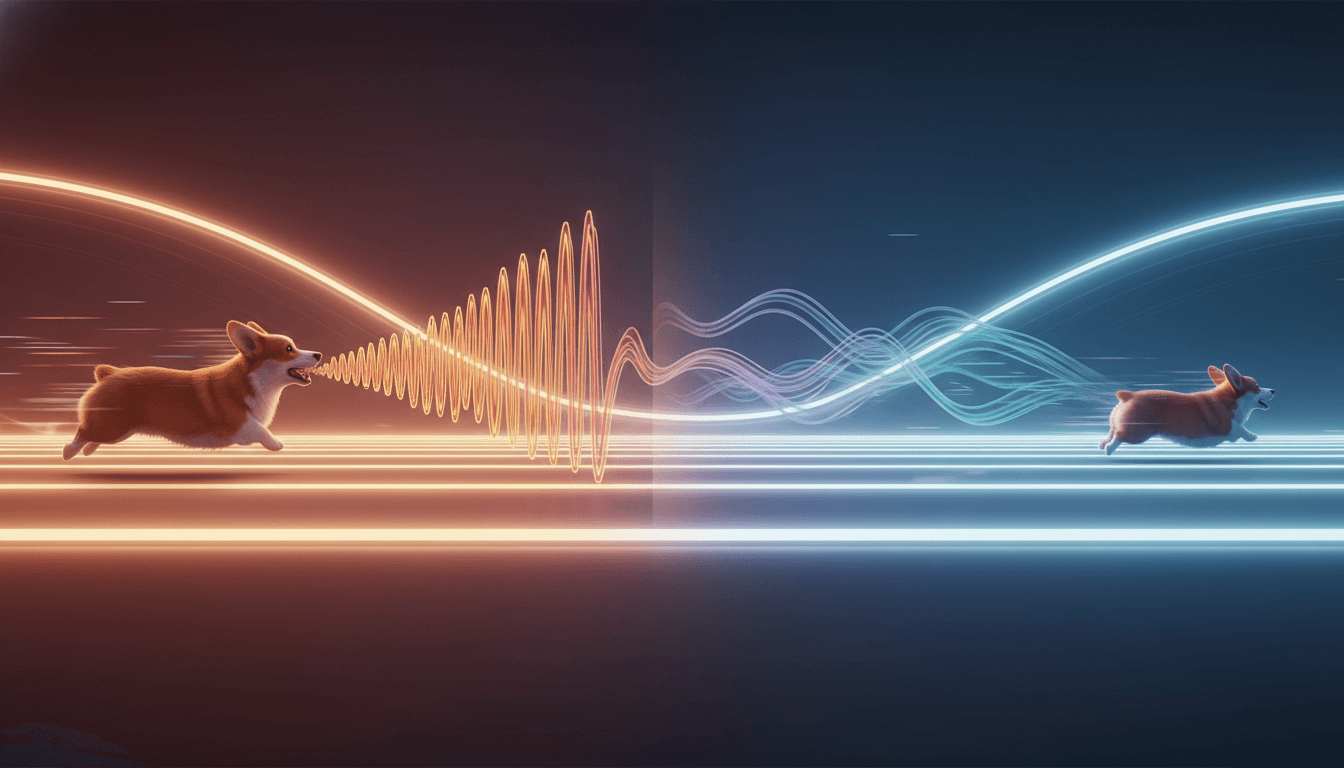
The central concept here is the Doppler Effect. You know how an ambulance sounds high-pitched as it races toward you (WEEEE) and low-pitched as it drives away (woooo)? That’s the Doppler Effect. Sound waves get “squished” together as the source moves toward you (higher pitch) and “stretched” out as it moves away (lower pitch).
Now, replace the ambulance with a 25-pound potato running at top speed. That is the Doppler-Corgi Shift.
1. The Source: Deconstructing the “Bork”

Before we measure the shift, we must understand the sound. Corgis are deceptively loud. Despite being the size of a carry-on bag, they possess a chest cavity that allows them to hit 120 decibels—roughly the volume of a chainsaw or a thunderclap.
We categorize their vocalizations into three scientific modes:
- The Boof: A low-frequency warning. usually reserved for suspicious leaves or the mailman.
- The Bork: The standard operating sound. Piercing, repetitive, and full of attitude.
- The Eep: An ultrasonic frequency emitted when the cheese drawer opens.
2. The Physics of “The Zoomie”

To get a Doppler shift, you need speed. Corgis achieve this through a thermodynamic event known as the FRAP (Frenetic Random Activity Period), colloquially known as “The Zoomies”.
This is when a Corgi’s internal energy (kibble) suddenly converts into kinetic energy (chaos). Despite having legs the size of carrot sticks, a Pembroke Welsh Corgi can clock speeds of 25 mph.
While 25 mph isn’t breaking the sound barrier, it is fast enough to create a measurable shift in pitch.
- The Approach: As the Corgi sprints toward you to demand a treat, the sound waves of its bark compress. The pitch rises.
- The Pass: As it realizes you don’t have a treat and zooms past, the waves stretch out. The pitch drops.
To the human ear, this shift is about one musical semitone. It’s subtle, but if you listen closely, a Corgi running laps around the coffee table actually sounds like a very angry musical instrument going slightly out of tune.
3. Aerodynamics: The Flight of the Loaf

Here is where the science gets truly shocking. To move fast, you need to be aerodynamic. Sports cars are wedge-shaped to slice through the air. Corgis are… not.
In the world of fluid dynamics, we measure “drag” (air resistance).
- Toyota Land Cruiser Drag Coefficient: ~0.66
- Loaf of Bread Drag Coefficient: ~0.57
Yes, you read that correctly. A loaf of bread is more aerodynamic than a Jeep.. Since a Corgi is biologically analogous to a loaf of bread, they are surprisingly efficient projectiles.
However, they suffer from two aerodynamic flaws:
- The Ears: Those giant radar dishes create massive air resistance. In “Sport Mode,” a Corgi will pin its ears back to reduce drag.
- The Fluff: Fur creates friction. A fluffy Corgi creates a turbulent wake of air (and glitter/hair) behind it, slowing it down.
4. Hydrodynamics: The Floating Butt Phenomenon

The Doppler effect changes when the medium changes from air to water. Corgis are not natural swimmers; they are more like bobbers.
Due to a high concentration of… let’s call it “buoyant adipose tissue”… a Corgi’s rear end is significantly more buoyant than its front end. This is scientifically documented as The Floating Butt.
When a Corgi swims, the butt floats up, pushing the head down. To compensate, they must tilt their heads skyward to breathe. This means they aren’t barking at you; they are barking at the International Space Station. This directs the sound waves upward, effectively negating the Doppler effect for anyone standing on the shore.
5. Conclusion: The “Good Boy” Variable

While the math proves that a zooming Corgi creates a pitch shift, there is one final variable: The Sass Interference Pattern.
Corgis are “talkers.” They modulate their pitch based on emotion, not just speed. A Corgi running towards you might lower its pitch into a grumble because you didn’t throw the ball fast enough. This biological “sass” often overpowers the physics.
So, the next time your low-rider engages in a high-velocity FRAP session, listen closely. You aren’t just hearing a dog go crazy; you are witnessing a furry experiment in wave mechanics, aerodynamics, and pure, unadulterated attitude.
This post was written for Planet of the Corgis. No bread loaves were thrown in the making of this science.
Follow Our Corgi Adventures!
Pinterest
Instagram
TikTok
YouTube