
Corgi in the Kitchen: A Serious, Scientific Look at the Ideal "Tail-to-Oven" Ratio for a Corgi to Become a Michelin-Star Chef
Published: 2026-01-22
If you have ever attempted to sear a scallop or julienne a bell pepper in a household containing a Pembroke Welsh Corgi, you are likely familiar with the phenomenon known to science as “Low-Altitude Obstruction.”
One moment, you are executing a perfect sauté; the next, you are tripping over a loaf of bread that is inexplicably vibrating, shedding, and demanding what we in the industry call “The Cheese Tax.”
This brings us to a critical, scientific question that has plagued culinary anthropologists, bored dog owners, and the editors of Bon Appétit for decades: Can a Corgi actually run a Michelin-star kitchen?
Most critics point to the obvious physical limitations: the lack of opposable thumbs, the tendency to shed “glitter” (fur) into the béchamel, and the vertical challenges associated with being a “low-rider” in a monster truck world. But here at the Institute of Canine Culinary Arts, we believe these are merely engineering challenges. Today, we are publishing our groundbreaking findings on the “Tail-to-Oven” Ratio, a mathematical framework that determines whether your pup is destined to run the Pass or is simply a menace to the Pantry.
This report will guide you through the rigorous science of Corgi ergonomics, the comedic tragedy of their culinary attempts, and—most importantly—the critical kitchen hazards for small dogs that you need to know to keep your little sous-chef safe.
The Physics of the Corgi Chef
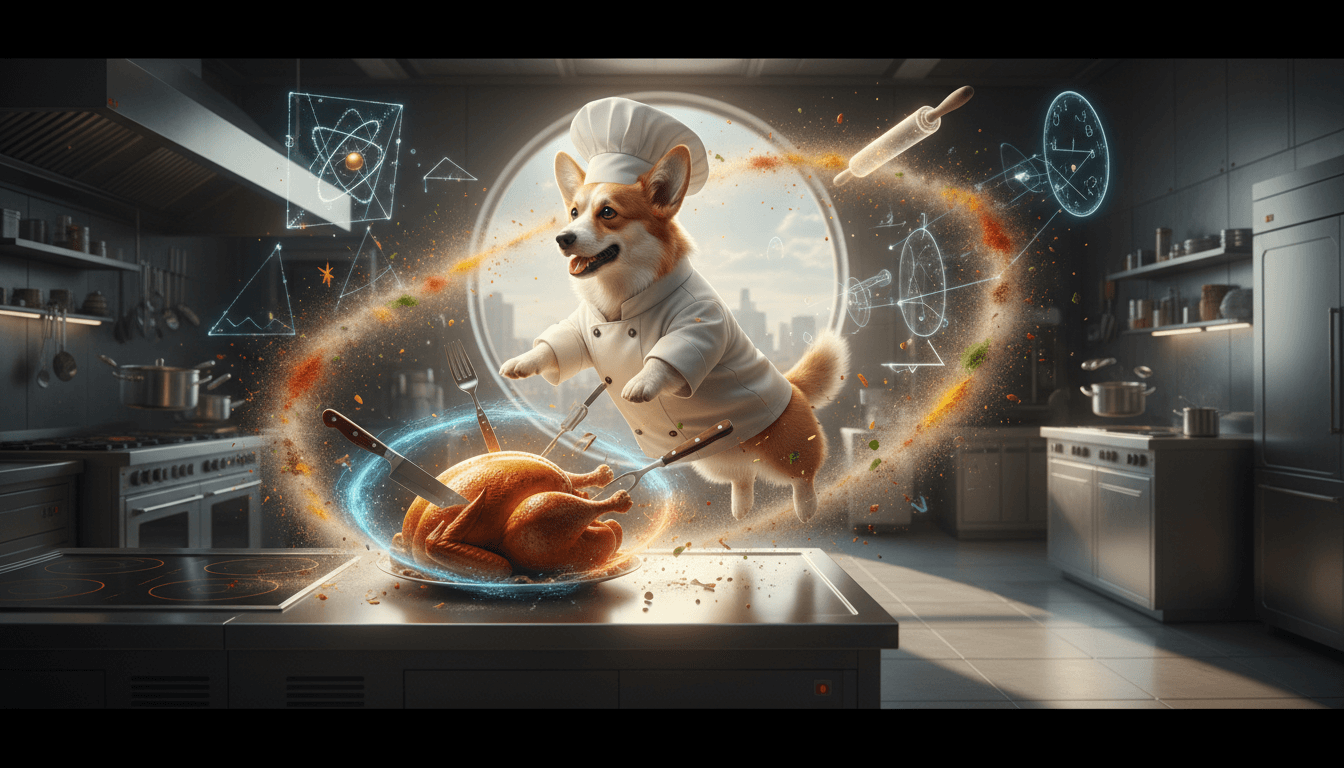
To understand the Corgi’s potential in a high-stakes kitchen, we must first analyze the ergonomics of the workspace versus the morphometrics (that’s fancy science talk for “shape”) of the dog.
The Vertical Deficit (The Countertop Conundrum)
The standard residential kitchen counter stands at exactly 36 inches from the floor. The standard Pembroke Welsh Corgi stands between 10 and 12 inches at the withers. Even with the neck fully extended in what we call the “Giraffe Maneuver”—usually deployed when bacon is sizzling—the Corgi achieves a maximum sensory height of perhaps 16 inches.
This leaves a Vertical Deficit of 20 inches.
In a professional kitchen, this is problematic. A Head Chef needs to inspect the mise en place. A Corgi Chef, however, can only inspect the floor. This leads to a unique culinary philosophy known as Floor-to-Table Dining, where the quality of the dish is determined solely by gravity. If it drops, it is approved. If it stays on the counter, it is ignored until it can be barked at.
The “Aerodynamic Meatloaf” Theory
We must also consider the drag coefficient of a Corgi. When a Corgi assumes the “Supervisory Sploot” position directly in front of the sink, they occupy the prime real estate of the kitchen triangle. Because they are designed like an aerodynamic meatloaf, the human chef is forced to engage in awkward ballet maneuvers to avoid stepping on them. Our data suggests that 90% of kitchen accidents involve a human trying to avoid a Corgi, only to trip over the Corgi’s own ego.
The “Tail-to-Oven” Ratio
Now, for the breakthrough science. The Tail-to-Oven Ratio (TTO) is the defining metric for Corgi culinary safety and success. It is a serious mathematical calculation that every owner should perform (preferably while holding a treat to keep the subject still).
The formula is as follows:

The Variables:
- Corgi Length: The average Corgi is roughly 22 to 26 inches of pure muscle and attitude.
- Sass Factor: A variable constant, usually calculated by how many times they have barked at the wind in the last hour.
- Oven Door Clearance: When a standard oven door opens, it protrudes roughly 20 inches horizontally into the kitchen.
The Result:
If you do the math, you realize that a Corgi standing parallel to the oven is statistically guaranteed to be in the “Crush Zone” when the door lowers. The handle of the oven is usually positioned at about 16.5 inches—exactly the height of a Corgi’s head.
The Ideal Ratio:
For a Corgi to safely operate as a Sous Chef (or “Sous Dog”), they must maintain a TTO that ensures their nose can smell the roast (The Maillard Reaction), but their rear end does not become a tripping hazard for the line cooks. If your Corgi’s TTO is too low, they are at risk of “Thermal Surprise”—the moment the oven opens and a blast of 400-degree air hits them right in the whiskers.
The Michelin Guide (Corgi Edition)
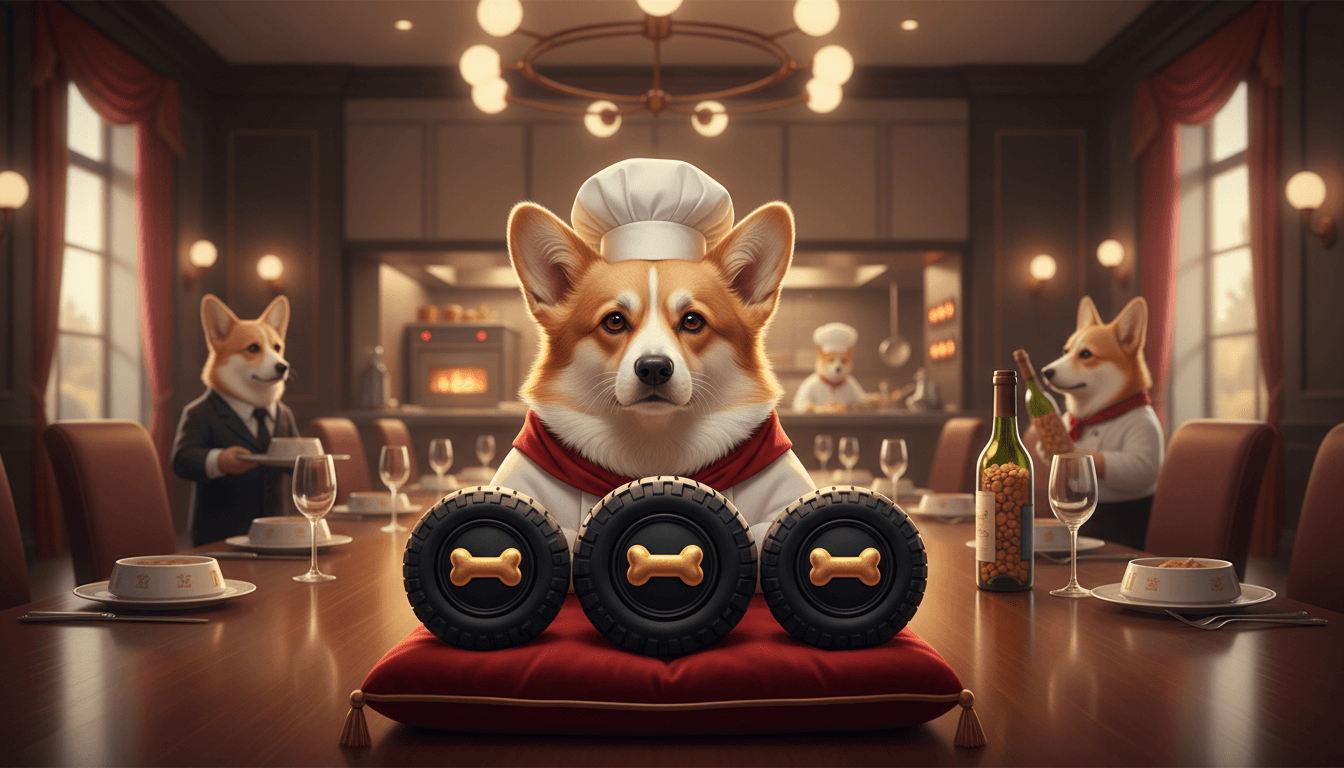
Let’s pretend for a moment that your Corgi has mastered the TTO Ratio and safely navigates the kitchen without tripping you. Do they have the artistic temperament for a Michelin star?
The Michelin Guide judges restaurants on five strict criteria. Let’s see how the Corgi stacks up against these rigorous standards.
Criterion 1: Quality of the Ingredients
Michelin Standard: Use of the freshest, highest-quality produce and proteins.
Corgi Standard: “I found this piece of dried kibble under the refrigerator. It is from 2019. It has aged like a fine wine. I shall eat it immediately.”
Verdict: FAIL. Corgis lack discernment. They will eat a Wagyu steak with the same enthusiasm they eat a used napkin. They are also known to engage in “Emulsification” of their own fur into your butter dish. If there is hair in the food, the Corgi claims it adds texture.
Criterion 2: Mastery of Flavor and Cooking Techniques
Michelin Standard: Perfect balance of acidity, texture, and temperature.
Corgi Standard: The Corgi palette is heavily biased toward “Umami” and “Forbidden Crunch.” The concept of “cooking” is foreign to them; they prefer the technique known as “Raw & Rapid,” where food is inhaled without chewing to prevent anyone else from getting it. They are also big fans of “Spherification,” which is the intense, hypnotic staring contest they have with a frozen pea rolling across the floor.
Verdict: FAIL. Although, their mastery of the “Vacuum Technique” (cleaning the floor of crumbs in under 3 seconds) is world-class.
Criterion 3: The Personality of the Chef in the Cuisine
Michelin Standard: The chef’s unique voice should shine through the dish.
Corgi Standard: Oh, the personality is there. If “sass” was a flavor profile, a Corgi’s dish would be spicy enough to melt steel beams. A Corgi chef would not serve you food; they would demand you serve them food, and then judge you for the portion size. Their “plating” technique usually involves knocking the bowl over to access the food faster.
Verdict: PASS. Too much personality, actually.
Criterion 4: Value for Money
Michelin Standard: Is the experience worth the price?
Corgi Standard: Corgis are expensive. Between the premium food, the orthopedic beds, and the sheer volume of lint rollers required to de-fur your life, the overhead costs are astronomical. However, the payment comes in the form of unparalleled cuteness and wiggly butts.
Verdict: PASS. Three Michelin stars for the sploot alone.
Criterion 5: Consistency Between Visits
Michelin Standard: Every meal must be perfect, every time.
Corgi Standard: A Corgi is the most consistent creature on earth. They will beg for breakfast at 7:00 AM. They will beg for dinner at 5:00 PM. They will bark at the delivery driver at 12:32 PM. You can set your atomic clock by their stomach.
Verdict: PASS. A Corgi’s hunger is as reliable as the tides.
The Serious Stuff (Kitchen Hazards for Small Dogs)
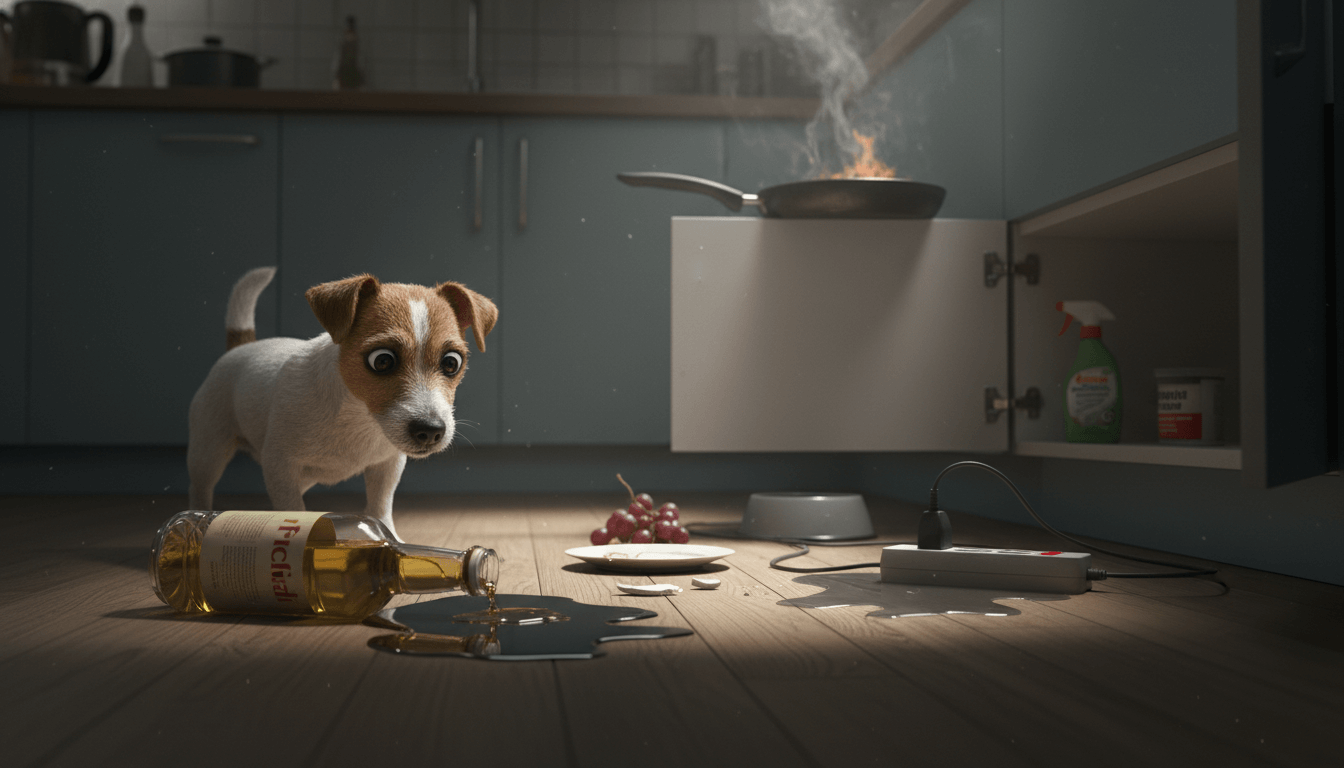
While we love the image of a Corgi in a tiny chef’s hat (and please, if you do this, tag us on Instagram immediately), the kitchen is arguably the most dangerous room in the house for your low-to-the-ground friend. To keep your Corgi safe—and to keep your kitchen running smoothly—you need to be aware of the specific hazards that threaten our vertically challenged companions.
1. The “Heat” is Real (Thermal Hazards)
Remember the TTO Ratio? It’s not just a joke. Because Corgis are low to the ground, they are often out of your direct line of sight when you are handling hot items.
- The Oven Door: As mentioned, the blast of heat from an opening oven hits a Corgi directly in the face and eyes. This can cause corneal burns or respiratory irritation.
- Boiling Water: When you drain pasta in the sink, steam rises, but splashes fall. A Corgi waiting at your feet for a dropped noodle is in the splash zone for scalding water.
- The Fix: Teach the “Place” command. When the oven or stove is on, the Corgi should be on their mat, visible but out of the way.
2. Toxic Foods for Dogs List (The Forbidden Pantry)
A Corgi’s opportunistic eating habits mean they are constantly scanning the floor for “samples.” In a prep kitchen, this is deadly. There are specific ingredients that every Corgi Chef is banned from using. You need to memorize this toxic foods for dogs list:
- The Forbidden Bulb (Onions, Garlic, & Chives): These are staples in human cooking, but they are toxic to dogs. They damage red blood cells and cause anemia. Even a small piece of dropped onion or a dash of onion powder is dangerous.
- The Silent Killer (Xylitol): This artificial sweetener is often found in peanut butter (always check the label!), gum, and some baked goods. It causes a rapid insulin spike leading to hypoglycemia and liver failure. It is incredibly potent and life-threatening.
- The Dark Matter (Chocolate): Everyone knows this one, but baking chocolate and cocoa powder are far more toxic than milk chocolate candy bars. If you are baking brownies and drop a chip, it is a medical emergency for a small dog.
- The Mystery Grape: Grapes and raisins can cause acute kidney failure in dogs. The scary part? We don’t know why, and we don’t know the dose. Some dogs eat a pound and are fine; others eat one raisin and go into failure. Treat every dropped raisin like a biohazard.
3. Dog Counter Surfing Prevention
You might think your Corgi is too short to counter-surf. You would be wrong. A motivated Corgi can achieve surprising vertical lift, or they use the “Cabinet Climb” technique.
- The Hazard: If they hook their paws on the edge of the counter, they can pull down heavy knife blocks, hot pans, or glass containers. It’s not just about them eating the food; it’s about the “Cascade Failure” of heavy objects falling on their spine.
- The Fix: Implement the “6-Inch Buffer Zone.” Get in the habit of pushing all food, knives, and heavy items 6 inches back from the edge of the counter. It’s a simple ergonomic change that saves lives.
4. The Trash Can Buffet
To a Corgi, the trash can is just a heavy-duty treat dispenser wrapped in plastic.
- The Hazard: Corn cobs, peach pits, and cooked bones found in the trash are major choking hazards. They can also cause intestinal blockages that require expensive surgery.
- The Fix: Invest in a trash can with a locking lid or, better yet, keep the trash inside a cabinet with a child-proof lock. Corgis are smart; they will figure out a foot pedal if given enough time.
The Sous-Chef We Deserve

So, will your Corgi ever earn a Michelin star? Probably not. They lack the thumbs for plating, their hygiene regarding “butt-wiggles” is questionable, and they are likely to eat the customers’ food before it leaves the pass.
But in the kitchen of life, they are the ultimate comfort food. They provide warmth (mostly by sitting on your feet), entertainment (watching them argue with a dishwasher), and unconditional love (especially when you are holding cheese).
Just keep them away from the chocolate soufflé, maintain a safe Tail-to-Oven ratio, and remember: in a Corgi’s world, every meal is a tasting menu, and you are just the waiter.
Bon Appétit!
Follow Our Corgi Adventures!
Pinterest
Instagram
TikTok
YouTube